Funding When You're an Individual, Not an Org

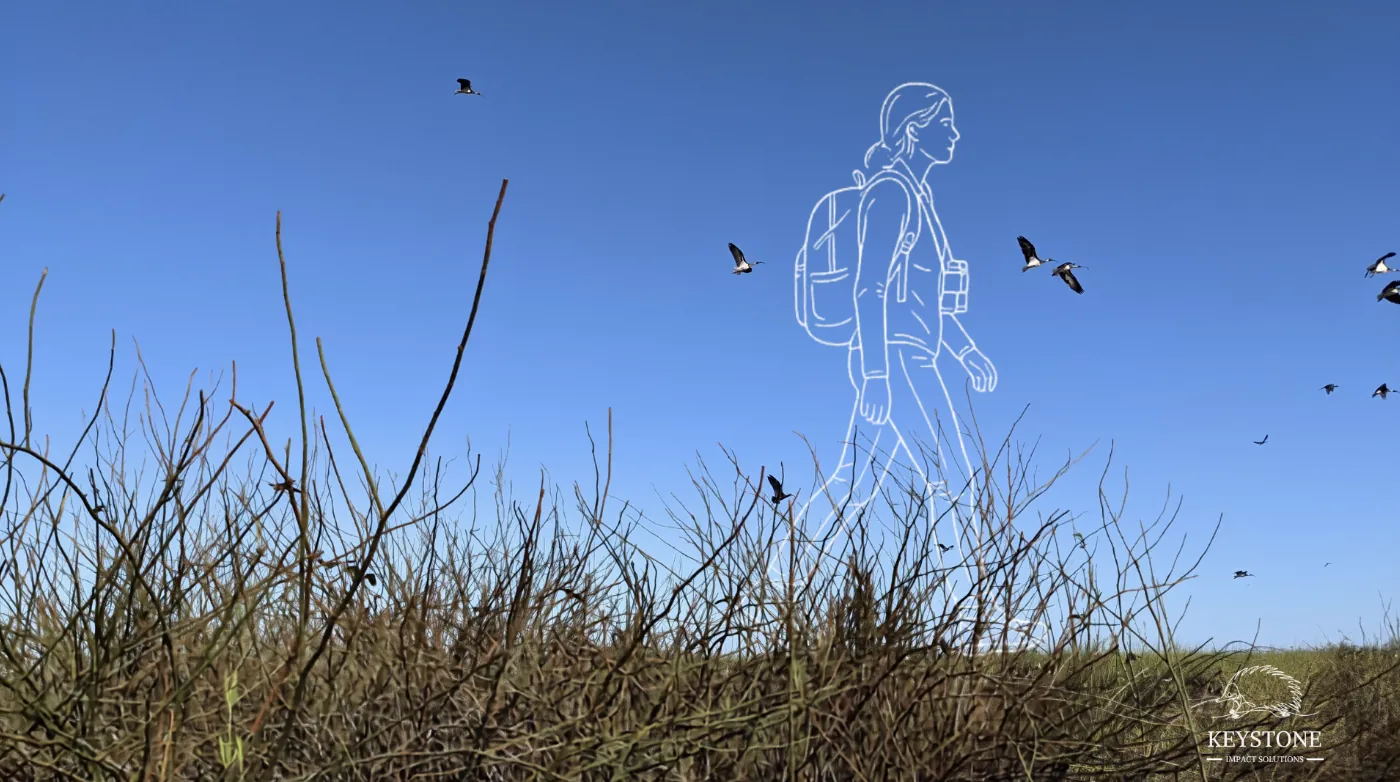
An illustrated figure of a woman with a backpack walking through open grassland under a wide blue sky, with birds in flight, Keystone Impact Solutions

A message arrived last week from an adventurer planning to retrace her ancestors' route across the Sahara. Two thousand five hundred kilometres on foot, walking the old caravan roads of her Amazigh forebears.

The Amazigh are the First Peoples of North Africa, and their culture is at real risk of extinction, pressed by climate change and the steady erasure of First Nation identities. The project is rooted in cultural preservation and Indigenous storytelling, and she's already done the hard parts: logistics, expert mentorship, and the long process of earning the right to tell this particular story.

Her question was about funding. And it was a great question, because the project doesn't fit standard grant categories. Too individual for most rounds. Too specific for general arts funding. Too expedition-heavy for cultural bodies, too cultural for expedition bodies.

Because the question she's asking is one I hear in different forms all the time, from people whose projects are too good to be ignored and too bespoke to be funded the traditional way.

The system wasn't built with individuals in mind

Most formal grant rounds are designed for registered organisations: charities, social enterprises, research institutes, councils, and businesses. The eligibility criteria assume an ABN, a board, audited financials, and an organisational track record. None of that is unreasonable from a funder's perspective. It reduces risk and creates a clear chain of accountability.

But it does mean that an individual with a purpose-driven project starts the conversation already filtered out. The project can be excellent and still fall at this hurdle. The form has a question they can't tick.

Insight

This is structural, not a verdict on the work

Being filtered out of an eligibility round is not a reflection of the project's legitimacy or the person leading it. Naming this clearly matters, because the alternative is to absorb the rejection as a verdict on the work itself. It isn't.

The funding does exist. You just have to know where to look and how to present yourself.

Three pathways worth knowing

Once you know that formal organisation-led rounds aren't your first stop, the picture opens up. For a project with expedition and cultural weight, three categories sit closest to the work.

  1. 01
    Expedition and exploration grants

    The most direct fit for this kind of project. The National Geographic Society, The Explorers Club, and the Royal Geographical Society all run programmes that fund individuals doing exactly this kind of work. Competition is fierce and seasonal, so timing matters as much as the application itself.

  2. 02
    Cultural preservation funding

    Bodies like UNESCO, alongside national arts and culture councils in most countries, hold specific allocations for Indigenous heritage and storytelling work. The framing here shifts from an expedition grant. The project is positioned as cultural work that happens to involve a long walk, rather than a long walk that happens to involve culture. For a project carrying the weight of Amazigh heritage, that framing is the truth of it.

  3. 03
    Sector-specific bodies

    The Sahara Conservation, for instance, exists for projects in that specific landscape. There are equivalents for almost every region and ecosystem. They tend to fly under the radar because they're niche, and niche is exactly what helps an individual project find a home.

None of these are easy money. They're competitive, they have rounds, and the applications are not simple. But they do fund individuals.

Fiscal sponsorship: the bridge most people don't know about

When a grant requires an organisational applicant and you don't have an organisation, fiscal sponsorship is the structural solution.

A registered organisation whose mission aligns with your project agrees to receive the grant funds on your behalf and administer them under their umbrella. You operate as a project of that organisation for the duration of the funding. They handle the compliance and reporting. You do the work.

What a lot of people don't realise is that building relationships is the funding work.

Dr Jess Hodgson

Fiscal sponsorship is a long-established mechanism, particularly in the arts, exploration, and cultural sectors. The National Council of Nonprofits has a clear, plain-language overview for anyone exploring it for the first time. The natural starting point is identifying a nonprofit already operating in your project's area or discipline and approaching them directly. They're putting their name and their compliance burden behind your work, so they need to trust you and believe in the project.

Corporate sponsorship is more achievable than people expect

Adventure projects with strong storytelling attached have a track record with corporate sponsors that most people don't realise exists.

Consider Karin Traeger Hermosilla, who recently funded a long cycling expedition through Patagonia almost entirely through corporate sponsorships: specialist equipment from several partners, plus one outdoor brand that came in with cash. The route mattered less than the storytelling. The expedition had a clear narrative, strong visual potential, defined deliverables, and a defined audience the brands wanted to reach. The sponsorship was a marketing investment for them, not a donation.

Tip

The framing shifts from asking for help to offering a partnership where a brand attaches to a story that resonates with the people they want to talk to. Outdoor and adventure brands are the obvious starting point, but the net is wider: documentary production companies, publishers, technology brands whose products you'll use in the field, airlines for travel-in-kind. The work is about mapping which brands have a genuine reason to want to associate with your story.

Framing is the part nobody coaches you on

Even with the right pathway identified, the way you speak to a funder decides what happens next.

Generic openings get filtered out fast. "I'm writing to seek funding for an important project" does not tell the reader anything they couldn't have assumed. The opening that lands is the one that puts them inside a specific scene: a particular moment, a real detail, the kind of thing that makes them lean forward instead of skim.

Tailoring matters too. Every funder has values, a mission statement, and stated priorities. Reading those carefully and reflecting them back, accurately, is the difference between an application that feels like it was written for them versus one that is clearly generic. Funders can tell when a proposal has been adapted from a template versus written specifically for them.

Key takeaways

What to take from this

  • Being filtered out of a formal grant round is structural, not a verdict on the project's quality. Most rounds were designed for organisations, not individuals.
  • Expedition grants, cultural preservation funding, and sector-specific bodies all fund individuals. The right category depends on how you frame the project, not just what the project is.
  • Fiscal sponsorship gives you access to organisational grant rounds without needing to be an organisation. Building the relationship with a mission-aligned nonprofit is the work.
  • Corporate sponsorship is a marketing investment, not a donation. Approach it as a partnership offer, not a funding request.

If you're sitting with a project that doesn't fit the usual pattern, I'd like to know what you're working on. Some of the most interesting funding conversations I've had this year started exactly that way.

← Back to Impact Intel

Dr Jess Hodgson

Keystone Impact Solutions

Work with KIS

Working on a project that doesn't fit the usual pattern?

If your project is too good to be ignored and too bespoke to be funded the traditional way, let's talk. I can help you identify the right pathways and position your work to reach the funders who are actually looking for it.

Get in touch

Stay informed

Funding intelligence, direct to your inbox.

Grant opportunities, sector updates, and practical strategy. Sent when there is something worth saying.